
Hitsats, Tigray: A Humanitarian Crisis Forgotten by the World
AI Generated
Batseba Seifu, GEM Tigray (Gender Empowerment Movement Tigray) and Woldegiorgis GHiwot Teklay, Yabele Media –
OCP Articles – 25/12/2025
The Hitsats internally displaced persons (IDP) camp in northwestern Tigray has become a grim symbol of ongoing civilian suffering amidst fragile peace in Ethiopia. Images and testimonies shared by a group of social media activists, particularly on an account known for its charity work on TikTok, exposed severe malnutrition and neglect in the camp during the second week of December 2025, triggering wider attention, media coverage, and fundraising campaigns.
The TikTok videos released by the activists show many elderly and kids starved and have not eaten their breakfast and lunch, and have severe health conditions.
Following the virality of the situation, the state broadcaster, Tigray Television, has also covered the humanitarian crisis on December 21, 2025, sharing a stark picture that shows people are dying not from active warfare but from starvation and a lack of basic health care. The situation highlights the failure of humanitarian responses to meet urgent needs years after the war has subsided.
Deaths from Starvation and Lack of Medical Care
Videos by the volunteer TikTokers showed starved and ill people who spoke barely, and according to Tigray Television’s field reporting, more than 50 internally displaced persons from Western Tigray have died at the Hitsats IDP camp since July 2025 due to severe food shortages and a lack of medical treatment. Journalists visiting the camp encountered elderly people, women, and children severely malnourished and physically weakened, many lying in worn out mattresses without access to basic healthcare for ailments.
Local authorities have warned that the crisis is a long-standing one. The administrator of Western Tigray is cited to have warned that over 300 displaced people have died at the camp since 2022 as a result of shortages of both food and medicine. These figures align with the findings by the Commission of Inquiry on Tigray Genocide which documented 325 deaths at the Hitsats IDP site alone. The commission had warned in its August 2025 comprehensive report on the plight of IDPs about the deteriorating situation in the 92 IDP sites in Tigray following the genocidal war.
Collapse of Aid Provision and Essential Services
Additional insight into the deterioration of conditions at Hitsats comes from individuals who have been directly involved in project work linked to the camp. An expert who participated in a humanitarian project at the site six months ago explained that the camp had previously been managed by the International Rescue Committee (IRC), which provided inclusive services, including water, sanitation, and hygiene, healthcare, and child protection.
However, according to the expert, the project was terminated without an adequate exit strategy in place. “As I understand, the government, specifically the North Western Zone, was informed. Unfortunately, there was a lack of an exit strategy and a failure to prepare alternative solutions. Consequently, this lack of planning led to the problem backfiring,” he reflects. Residents of the camp, whose names have been changed for safety purposes, approached by the expert, have also confirmed the collapse of the services and explained their living conditions six months ago.
Fana, a female head of household, told the expert:
“I complained to the Woreda [district] social affairs office that I had not received any support for a long time. The resources allocated to the area were unfairly distributed, particularly by the camp committee members. Distribution was based on personal relationships.”
Letebirhan described the complete breakdown of water and health services:
“Currently, there is no water. We are drinking the same water as animals. Everything has been cut off—no water, no medicine. We are left with many unanswered questions.”
Azmera added that infrastructure failures directly followed the end of the humanitarian project:
“The water system ceased to function after the project concluded. We are now forced to drink water from the river, exposing our children to various waterborne diseases.”
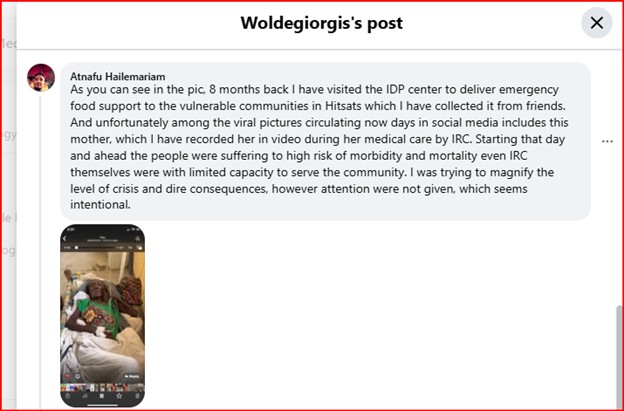
Another person, Atnafu Hailemariam, who is active on social media and visited the site eight months ago, testifies to what he saw under a Facebook post by one of the authors of this piece.
Inadequate Food Aid and Desperate Choices
IDPs at Hitsats reported that food distributions —approximately 15 kilograms per household per cycle — are far below families survival needs. Households often sell part of this limited food aid to purchase medicine and other essential necessities, leaving them with less to eat and accelerating malnutrition, according to the state media report.
Camp residents also described the food aid provided as nutritionally inadequate, particularly for the elderly, children, and individuals with health issues who require more digestible or medically appropriate nutrition that is entirely absent.
Danger of Further Deaths Without Urgent Aid
Tigray Television’s coverage quotes local administrators and residents warning that more than 1,700 displaced people in the camp are on the brink of death if immediate and sustained humanitarian assistance does not become available. Without a rapid scale-up in food and medical support, more deaths are imminent.
While these figures reflect a crisis specific to Hitsats, they mirror broader patterns across Tigray. Refugees International reported in 2024 that the Tigray Health Research Institute estimated that between December 2022 and August 2023, approximately 68 percent of deaths in the region were caused by starvation, with the majority occurring in IDP sites.
Protracted Displacement from Western Tigray
All displaced people at Hitsats come from Western Tigray, where large-scale forced displacement occured during the war between November 2020 and November 2022. Even after formal cessation of large-scale hostilities, they remain unable to safely return home due to unconstitutional and forceful occupation. Tigray Television’s report links the ongoing humanitarian crisis to continued displacement and a lack of secure conditions for return. Tigrayans universally, regardless of political differences, attribute the problem at Hitsats and other displacement sites directly to this unresolved displacement and the absence of safe, voluntary return conditions.
History of Recurrent Vulnerability
While the current crisis affects a different population—Tigrayan IDPs rather than Eritrean refugees, who were affected heavily during the war—the region’s history underscores prolonged civilian vulnerability and civilians’ limited safety and access to aid and protection.
Post-Peace Agreement Reality
The Pretoria Peace Agreement, signed in November 2022, promised improved humanitarian access and civilian protection. The conditions at Hitsats and other displacement sites, however, illustrate a significant gap between political commitments and on-the-ground relief delivery. Despite formal mechanisms to facilitate aid, displaced communities continue to suffer from chronic shortages of food, medicine, and basic services, indicating that peace processes have not yet translated into meaningful protection or life-saving support for all affected populations. Furthermore, continued displacement due to forceful, unconstitutional occupation has continued to generate negative impact on communities.
Independent humanitarian assessments confirm that aid delivery remains insufficient Refugees International notes that displaced people’s access to food aid remains limited, contributing to ongoing malnutrition and deaths even after the cessation of major hostilities.
A Call for Urgent Action
The situation at Hitsats IDP camp and other displacement sites is a stark reminder that people are dying not from bullets, but from hunger and a lack of medical care—deaths that are preventable with adequate and sustained humanitarian support and the safe, dignified, and voluntary return of the displaced.
Urgent attention is required to this crisis – urgent need for increased food assistance, medical supplies, and robust humanitarian access to protect displaced civilians. Unless immediate action is taken by national and local authorities, aid agencies, and international donors, Hitsats and other IDP sites will continue to register preventable fatalities in a crisis that has been widely forgotten by the world because it simply happens to be taking place in Africa.
